
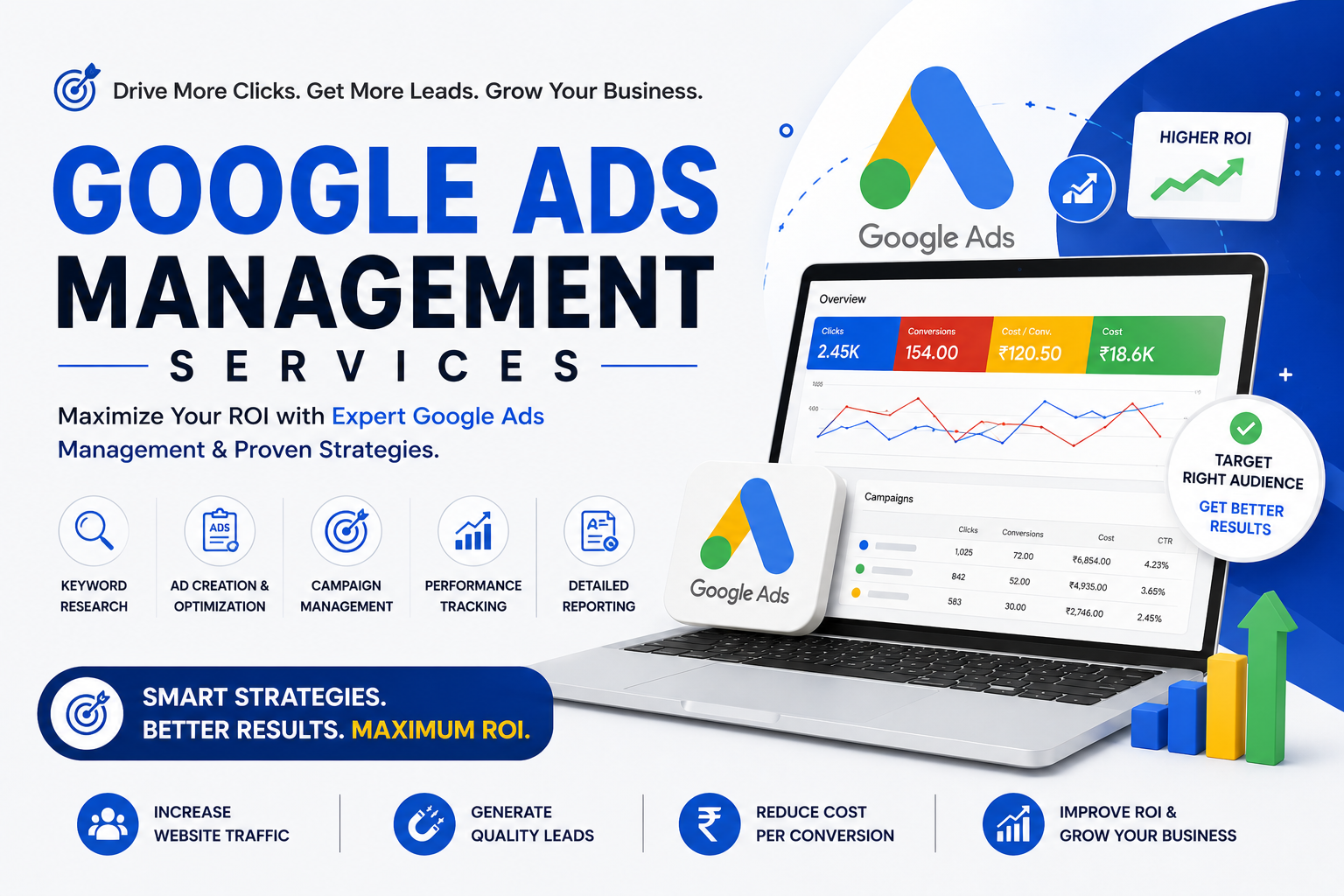
What Google Ads Management Actually Involves
Running a profitable Google Ads account is not about writing a few ads and picking a daily budget. It requires a defensible account structure, conversion tracking that survives Google's own signal loss (Consent Mode, iOS restrictions, cookie deprecation), bid strategies matched to actual sales cycles, and a review cadence that catches wasted spend before it compounds. Urgent IT Solution manages Search, Shopping, Performance Max, Display remarketing and YouTube campaigns for businesses that already know Google Ads works for their category but are tired of an account that burns budget without a clear line to revenue.
We work with two very different types of clients on this front: businesses that have never run paid search and need an account built from zero, and businesses with an existing account full of legacy campaigns, broad match keywords with no negatives, and conversion tracking that double-counts leads. The second case is more common, and it usually requires an account audit before any new spend is approved.
Account Audit Before Account Rebuild
If you already have an active account, we start with a structural audit: search terms report review for wasted spend, match type distribution, quality score trends, conversion action setup in Google Ads and GA4, attribution model, and whether Enhanced Conversions or offline conversion imports are configured. This tells us whether the problem is targeting, ad copy, landing pages, tracking accuracy, or simply an unrealistic budget for the CPC in that category. Skipping this step is how agencies end up "optimizing" a campaign whose real problem is that conversion tracking is firing twice per form submission.
Campaign Structure and Match Type Strategy
We build campaigns around commercial intent tiers rather than dumping every keyword into one ad group. Branded terms, high-intent transactional terms, and awareness/informational terms get separated so budget allocation and bid strategy can differ across them. Match type choice is deliberate: phrase and exact match for terms where cost-per-click is high and intent must be tightly controlled, broad match only where paired with strong negative keyword lists and Smart Bidding that has enough conversion volume to learn from. For Shopping and Performance Max, structure depends on product feed segmentation, margin tiers, and whether cannibalization between campaigns is a risk.
Bidding Strategy: Manual, Enhanced CPC, or Automated
Automated bidding (Maximize Conversions, Maximize Conversion Value, Target CPA, Target ROAS) only performs well when there is enough conversion volume feeding the algorithm and conversion values are accurate. For accounts with fewer than roughly 30 conversions a month, we often start with manual CPC or Enhanced CPC while we build tracking maturity, then move to automated strategies once volume supports it. For ecommerce accounts, Target ROAS depends entirely on whether transaction values passed to Google reflect actual margin, not just revenue - we flag this early because it changes what "good ROAS" even means for that account.
Negative Keywords and Search Term Mining
Ongoing negative keyword management is one of the highest-leverage, least glamorous parts of account management. We review search term reports on a fixed schedule, add negatives at both campaign and shared list level, and track how much spend was avoided as a result. This is where a lot of budget leaks in accounts that were "set up and left running."
Conversion Tracking and Measurement
An account is only as good as what it thinks it's optimizing toward. We set up Google Ads conversion actions, GA4 event-based conversions, call tracking where phone leads matter, and offline conversion import for businesses where the real sale happens days or weeks after the click (B2B lead forms, real estate inquiries, service quotes). Where third-party cookie limitations affect measurement, we implement Enhanced Conversions and server-side tagging via Google Tag Manager so bidding algorithms keep working with reasonably complete data. Without this, Smart Bidding is optimizing against a signal that's already degraded, and no amount of ad copy testing fixes that.
Attribution and Reporting
We report against the metrics that matter for the business model - cost per qualified lead, not just cost per click; blended ROAS across Search and Shopping, not campaign-level vanity numbers. Reporting includes what changed in the account that period (bid adjustments, new negatives, ad tests concluded) alongside the resulting numbers, so the client can see cause and effect rather than a static dashboard.
Ad Creative and Landing Page Alignment
Responsive Search Ads need enough headline and description variation to let Google's combination testing actually differentiate, but each asset still has to be individually accurate - we don't submit filler headlines just to hit the asset count. Ad relevance also depends on landing pages matching search intent; if the ad promises a price range or specific service and the landing page is a generic homepage, quality score and conversion rate both suffer. Where landing pages are the bottleneck, we flag that as a website issue separate from the ad account, since no bid strategy fixes a page that doesn't convert.
Performance Max Considerations
Performance Max campaigns trade granular control for automated cross-channel reach, which makes them powerful for ecommerce with a solid product feed but risky for lead-gen accounts without careful audience signals and asset group segmentation. We use PMax selectively, monitor for search term insights and channel-level performance where visible, and avoid letting it cannibalize a well-performing Search campaign without evidence it's adding incremental conversions.
Ongoing Management Cadence
Accounts get reviewed on a fixed schedule rather than only when performance drops: bid and budget checks, search term mining, ad testing rotation, and quality score/landing page experience review. Budget changes are tied to actual data - a campaign doesn't get more budget just because it hasn't spent through, and it doesn't get cut just because of a single slow week if the underlying trend is stable.
Who Needs Managed Google Ads
This service fits businesses with a defined conversion path (a form, a call, a purchase) and enough margin per conversion to justify paid acquisition cost - local service businesses competing on high-CPC terms, B2B companies with long sales cycles needing offline conversion import, and ecommerce stores running Shopping and PMax alongside Search. It's a poor fit for businesses without a working landing page or tracking foundation; in those cases we recommend fixing that first, since ad spend on an unmeasured or unconverting funnel is money spent finding out what you should have fixed before launch.