
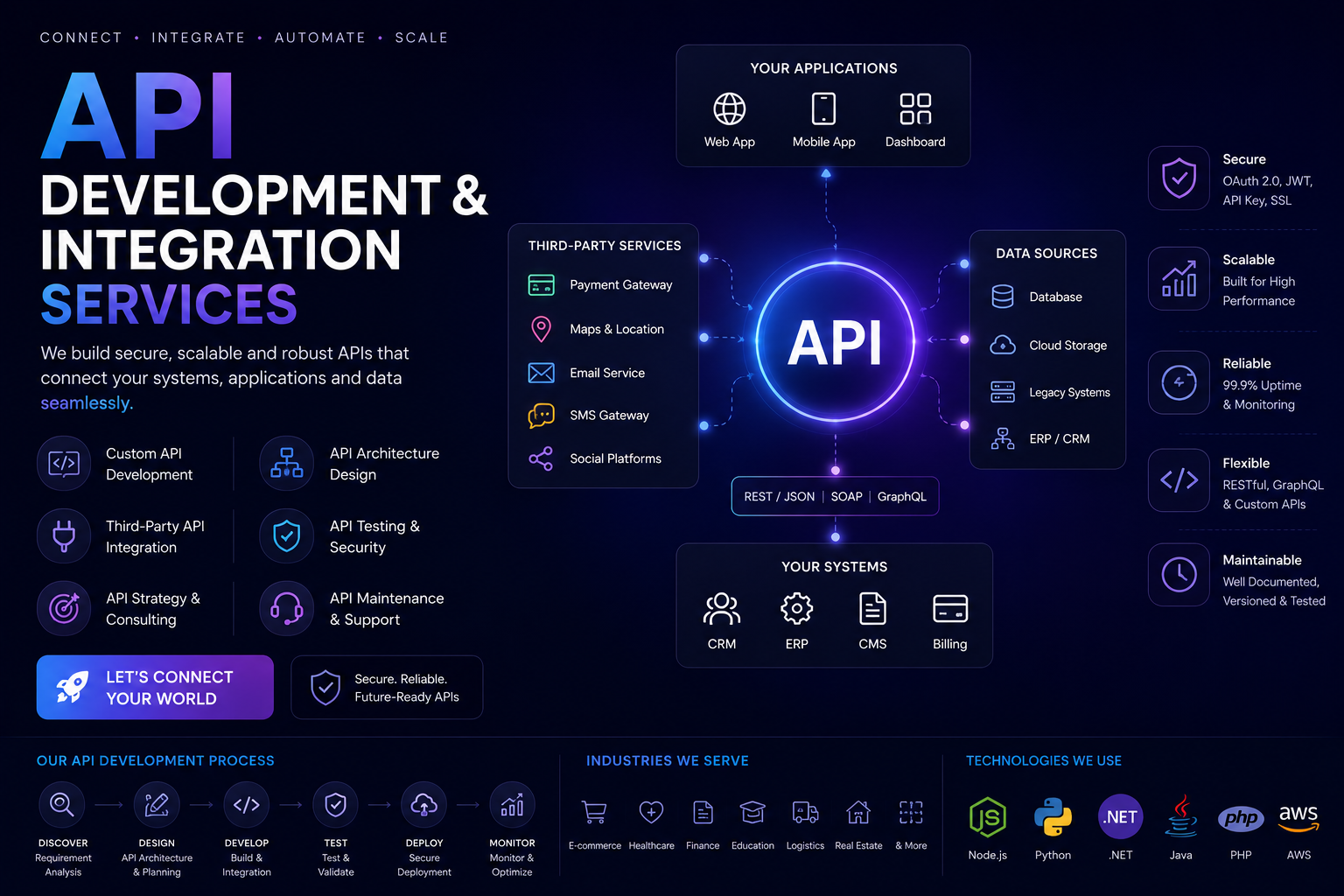
What "API Development and Integration" Actually Covers
An API project is really two different jobs that get lumped under one name. The first is API development: designing and building endpoints that expose your own data or business logic so other systems can use it - a mobile app calling your order database, a partner pulling inventory levels, an internal tool triggering a workflow. The second is API integration: wiring your systems into someone else's API - Razorpay or Stripe for payments, Shiprocket or Delhivery for logistics, Tally or Zoho Books for accounting, WhatsApp Business API for messaging, or a CRM like Salesforce or HubSpot. Most requests we get are a mix of both: build an internal API layer, then integrate three or four external services behind it so the frontend only talks to one clean interface.
REST, GraphQL, SOAP or Webhooks - Which One
REST with JSON is still the default for most business systems because tooling, caching and documentation (OpenAPI/Swagger) are mature and every platform supports it. GraphQL earns its complexity when a mobile app and a web dashboard need very different slices of the same data and you want to avoid over-fetching or maintaining ten REST endpoints for slight variations. SOAP still shows up in banking, insurance and government integrations where WSDL contracts are non-negotiable - we support it when a partner mandates it, not by default. Webhooks matter for anything event-driven: payment confirmations, shipment status changes, subscription renewals - instead of polling an API every few minutes, the third-party system pushes data to your endpoint when something happens, which cuts server load and latency.
How We Approach a New Integration or API Build
Mapping the Actual Data Flow First
Before writing a route or an endpoint, we map what data moves where, how often, and what happens if a call fails halfway through. For a payment gateway integration, that means tracing the full lifecycle - initiate, capture, webhook confirmation, refund, dispute - not just the happy path. For an ERP-to-e-commerce sync, it means deciding whether inventory updates flow one-way or need reconciliation logic when both systems can be edited independently. This mapping stage catches problems - rate limits, missing fields, timezone mismatches, currency conversion - before they become production bugs.
Authentication and Access Control
We implement OAuth 2.0 for third-party and partner-facing APIs, JWT for stateless session handling in single-page apps and mobile clients, and API keys with scoped permissions for simpler machine-to-machine calls. For internal microservices, we set up mutual TLS or service-mesh level authentication where the traffic never leaves a private network. Every API we build ships with rate limiting, request validation, and versioning (typically via URL path or header) so a v2 release doesn't break clients still calling v1.
Error Handling That Doesn't Just Log and Forget
A failed API call needs a decision, not just a log entry. We build retry logic with exponential backoff for transient failures, dead-letter queues for messages that repeatedly fail (common in webhook-based integrations), and idempotency keys for payment and order-creation endpoints so a retried request never double-charges a customer or duplicates an order. For synchronous integrations we set sensible timeouts rather than letting a slow third-party API hang the entire checkout flow.
Common Integration Scenarios We Handle
- Payment gateways: Razorpay, PayU, Stripe, PayPal, Cashfree - including recurring billing, split payments and reconciliation reports.
- Logistics and shipping: real-time rate calculation, label generation, tracking webhooks from carriers like Delhivery, Shiprocket, Bluedart.
- ERP and accounting sync: connecting Tally, Zoho Books, SAP Business One or QuickBooks with e-commerce or custom software so invoices, stock and ledgers stay consistent without manual re-entry.
- CRM and marketing tools: pushing leads and events to HubSpot, Salesforce, Zoho CRM, or triggering email/SMS/WhatsApp flows from customer actions.
- Legacy system bridging: exposing a REST or GraphQL layer over an older SOAP service or an on-premise database so newer applications don't need to talk to legacy protocols directly.
- Internal microservice APIs: when a monolith is split into services, each needs a stable internal API contract with its own versioning and monitoring.
Documentation and Handover
An API without documentation becomes a support ticket generator. We provide an OpenAPI/Swagger specification for every REST API we build, including request/response examples, error codes and authentication flow, so your internal team or a partner developer can start integrating without a call with us first. For integrations we deliver a data-flow diagram showing which system owns which field, what triggers a sync, and what happens on failure - this becomes the reference document when something breaks eighteen months later and nobody remembers the original logic.
Testing and Monitoring Before and After Go-Live
We test against sandbox/staging credentials for every third-party service before touching production keys, and we specifically test failure paths - what happens when the payment gateway times out, when a webhook arrives twice, when the carrier API returns a malformed response. Post-launch, we set up monitoring on API response times and error rates (using tools like Postman monitors, custom logging dashboards, or platform-native monitoring depending on the stack) so a silent failure in a third-party service gets flagged before it becomes a week of missing orders.
When You Need This vs When You Don't
If you're connecting two or three well-documented SaaS tools with standard triggers, a middleware platform like Zapier or Make might genuinely be enough, and we'll say so rather than building custom code you don't need. Custom API development earns its cost when you have proprietary business logic, volume that exceeds no-code platform limits, security or compliance requirements that rule out third-party middleware, or when you're building the API layer that your own mobile app or partner ecosystem will depend on long-term. We scope this honestly during the first conversation rather than defaulting to the more expensive option.
Ongoing Support After Launch
Third-party APIs change - providers deprecate versions, rotate authentication methods, or alter rate limits without much warning. We offer maintenance arrangements where we monitor for breaking changes from the APIs you depend on and patch your integration before it fails in production, rather than after a customer reports a broken checkout.