
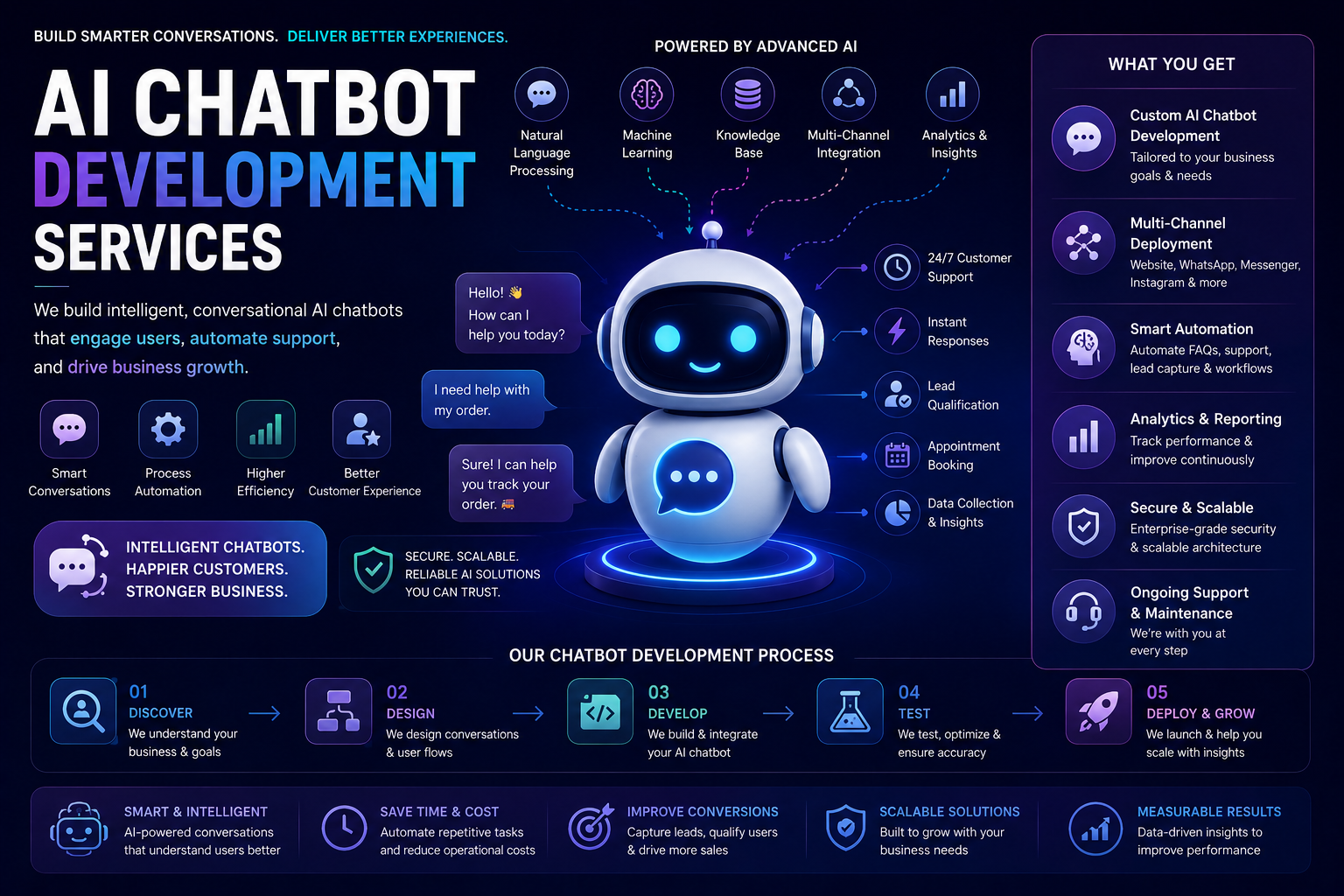
What "AI Chatbot Development" Actually Means Here
A chatbot that answers three FAQ questions and breaks on the fourth is not an AI chatbot - it's a decision tree with a chat bubble. Real AI chatbot development means building a system that understands intent from free-form text or voice, retrieves the right information from your actual business data, and either answers correctly or hands off to a human with full context. That requires choosing between rule-based NLU, retrieval-augmented generation (RAG) over an LLM, or a hybrid of both - and the right choice depends on how variable your users' phrasing is and how much your answers depend on data that changes daily (pricing, inventory, order status, policy documents).
Urgent IT Solution builds these systems around three architecture patterns depending on the use case: intent-classification bots for structured, high-volume queries (order tracking, appointment booking); RAG-based assistants for knowledge-heavy support (product documentation, HR policies, technical manuals); and hybrid agents that combine both with function-calling to trigger real actions like creating a ticket, updating a CRM record, or checking live inventory through an API.
Where This Gets Used in Practice
Customer Support Deflection
The bot sits in front of your existing help desk, answers repeat questions using your actual knowledge base and past ticket resolutions, and escalates to a human agent with the full conversation transcript and detected intent attached - so the agent isn't starting from zero.
Lead Qualification and Routing
On a website or landing page, the bot asks the same qualifying questions a sales rep would (budget, timeline, use case, company size), scores the lead against rules you define, and pushes qualified leads into your CRM (HubSpot, Zoho, Salesforce) with the conversation attached instead of a blank form submission.
Internal Knowledge Search
For teams drowning in scattered PDFs, wikis, and SOP documents, an internal chatbot indexes that content into a vector store and lets employees ask plain-language questions - "what's our refund policy for enterprise clients" - and get a sourced answer instead of searching five different SharePoint folders.
Workflow Automation via Chat
Some bots aren't answering questions at all - they're the interface for a process: submitting an expense report, requesting leave, checking shipment status by order number. Here the "AI" part is mostly intent capture; the value is in the API integrations that execute the actual task.
The Technical Stack We Actually Use
Depending on scope and budget, this can mean OpenAI or Anthropic models via API with a custom RAG layer (embeddings stored in Pinecone, Weaviate, or pgvector, chunked and retrieved with LangChain or a custom retrieval pipeline), open-source models self-hosted where data residency matters, or platform-based builds on Dialogflow, Microsoft Bot Framework, or Rasa when the client already has infrastructure investment there. For WhatsApp and Instagram deployment we integrate through the official WhatsApp Business API or Meta's Graph API rather than unofficial wrappers, since those break without notice.
Front-end delivery varies by need: an embedded widget on a website, a Slack or Microsoft Teams app for internal tools, a WhatsApp Business number for customer-facing retail and services, or a headless API that your existing app calls directly.
Handling the Hard Parts: Hallucination and Escalation
An LLM-based bot that confidently invents a return policy is a liability, not a feature. We constrain responses with retrieval grounding (the model only answers from provided source documents, with citations where useful), confidence thresholds that trigger human handoff instead of a guess, and explicit guardrails against giving advice outside the bot's defined scope - especially relevant in healthcare, finance, and legal-adjacent use cases where an ungrounded answer creates real risk.
Data and Integration Work Nobody Mentions Upfront
The chatbot itself is often the smaller half of the project. The bigger effort is usually: cleaning and structuring existing FAQ/knowledge content so it's retrievable, building the API connectors to your CRM, helpdesk, ERP, or booking system, and setting up the analytics layer to track what users are actually asking versus what the bot can currently answer. We scope this explicitly at the start rather than discovering it mid-build, because integration work is where timelines and budgets usually slip.
Our Delivery Process
- Conversation audit: we review existing support tickets, chat logs, or call transcripts (where available) to find the actual top intents, not assumed ones.
- Scope and architecture decision: intent-based, RAG, or hybrid, with the integrations and escalation rules defined before any building starts.
- Prototype on real content: a working version tested against your actual documents and sample queries, not generic demo data.
- Integration build: CRM, helpdesk, messaging channel, and any action-triggering APIs.
- Testing against edge cases: ambiguous phrasing, out-of-scope questions, adversarial inputs, and multi-turn context retention.
- Launch with monitoring: conversation logs and fallback rates tracked from day one so gaps in coverage show up quickly.
Post-Launch: Where Most Chatbots Actually Fail
A chatbot's accuracy degrades as your product, pricing, or policies change and the knowledge base isn't updated. We set up a maintenance cadence - reviewing fallback logs (queries the bot couldn't handle), retraining or re-indexing content, and adjusting escalation rules - because a bot frozen at launch quality within a few months is a common and avoidable failure mode.
How to Tell if You Need One
This is a reasonable investment if you have repetitive, answerable support volume that's currently consuming agent time, a knowledge base or documentation set large enough that manual search is slow, or a lead-qualification process that a rep is already doing manually and mechanically. It's usually the wrong investment if your query volume is low, your policies change too frequently to maintain a knowledge base, or your support issues are mostly complex, judgment-heavy cases that genuinely need a human - no retrieval architecture fixes that.