
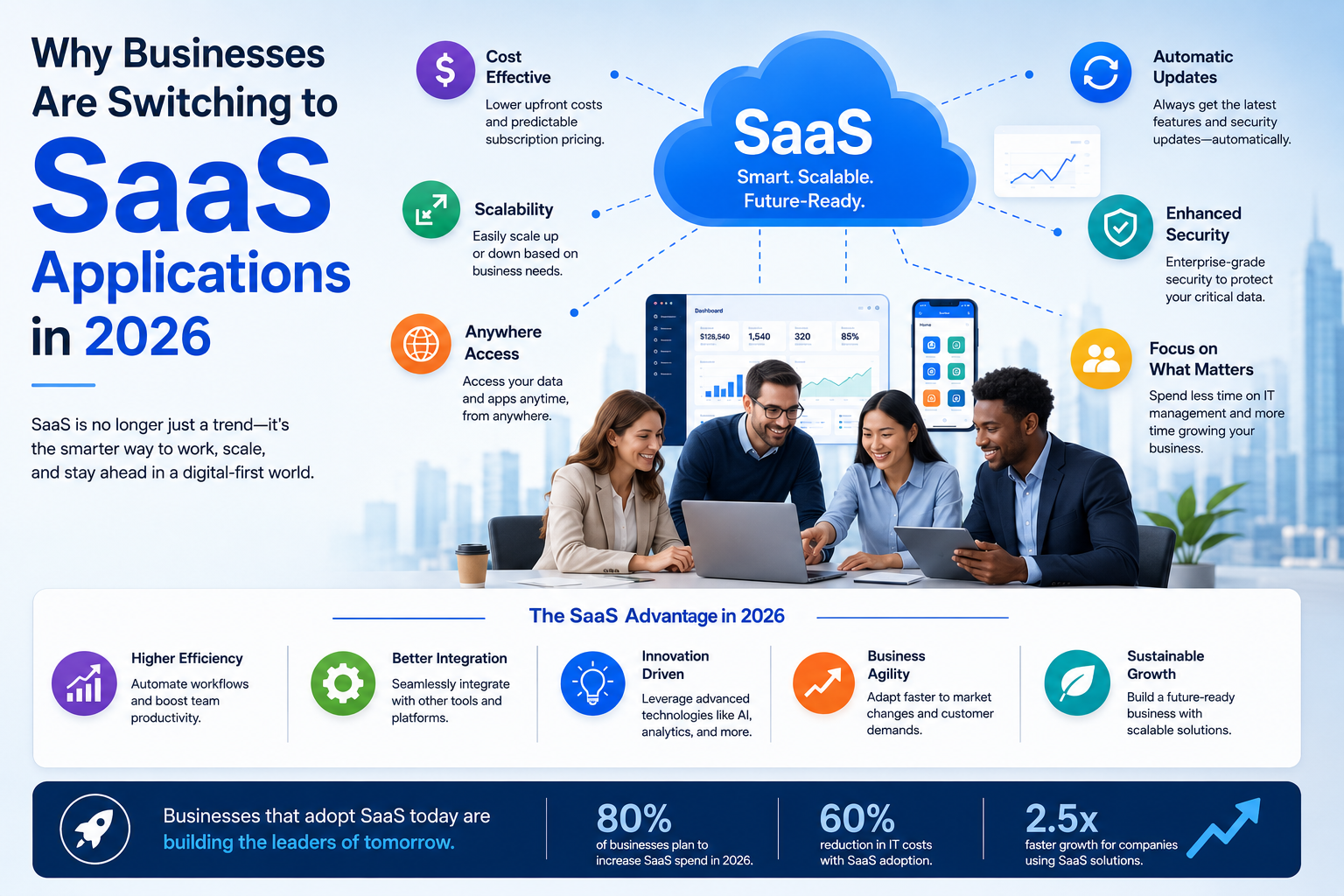
Why Businesses Are Switching to SaaS Applications in 2026
Technology is changing the way businesses operate. Companies now want faster systems, lower infrastructure costs, better collaboration, and scalable software solutions. This is why many organizations are moving from traditional software to SaaS applications.
SaaS (Software as a Service) has become one of the most popular business software models in 2026 because it offers flexibility, remote access, automatic updates, and cost-effective operations.
From startups to enterprises, businesses across industries are adopting SaaS solutions to improve efficiency and accelerate growth.
In this blog, we will explain why businesses are switching to SaaS applications and how SaaS software is transforming modern business operations.
What is SaaS Application?
SaaS (Software as a Service) is cloud-based software that users can access through the internet without installing it on local systems.
Instead of purchasing software permanently, businesses use SaaS applications through monthly or yearly subscriptions.
Examples of SaaS applications include:
- CRM software
- ERP systems
- Project management tools
- Accounting software
- HR management systems
- Cloud storage platforms
SaaS software is hosted on cloud servers and can be accessed from anywhere.
Benefits of SaaS Applications for Businesses
1. Lower Initial Investment
Traditional software requires:
- Hardware setup
- Server infrastructure
- Installation cost
- IT maintenance
SaaS applications reduce these costs because everything is hosted in the cloud.
Businesses can start quickly with minimal investment.
2. Access From Anywhere
Employees can access SaaS software from:
- Office
- Home
- Mobile devices
- Remote locations
This supports remote work and improves operational flexibility.
3. Automatic Software Updates
SaaS providers automatically update software with:
- New features
- Security patches
- Performance improvements
Businesses do not need manual installation or maintenance.
4. Better Team Collaboration
SaaS applications allow teams to work together in real time.
Employees can:
- Share files
- Update records
- Track projects
- Communicate faster
This improves productivity and workflow management.
5. Scalability for Business Growth
As businesses grow, SaaS applications can scale easily.
Companies can add:
- More users
- Additional modules
- Advanced features
- Extra storage
without changing the complete system.
6. Improved Data Security
Modern SaaS platforms include advanced security features such as:
- Data encryption
- Secure login systems
- Backup solutions
- Multi-user access control
This helps businesses protect important data.
7. Faster Deployment
Traditional software setup can take weeks or months.
SaaS applications can often be deployed within days.
This helps businesses save time and start operations faster.
8. Better Business Automation
SaaS applications automate many business tasks like:
- Billing
- Reporting
- Notifications
- Customer management
- Attendance tracking
- Workflow approvals
Automation improves efficiency and reduces manual errors.
Industries Using SaaS Applications in 2026
SaaS solutions are widely used in:
- Education
- Healthcare
- Real estate
- Retail
- Finance
- IT companies
- Logistics
- Manufacturing
Businesses in these industries use SaaS applications to improve operations and customer experience.
SaaS Applications vs Traditional Software
| Feature | Traditional Software | SaaS Applications |
|---|---|---|
| Installation | Required | Not Required |
| Access | Local System | Anywhere |
| Updates | Manual | Automatic |
| Infrastructure | Expensive | Lower Cost |
| Scalability | Limited | Flexible |
| Maintenance | High | Lower |
| Deployment Time | Slow | Fast |
Why SaaS is the Future of Business Software
Businesses today need:
- Remote accessibility
- Faster operations
- Business automation
- Lower maintenance
- Real-time collaboration
- Better scalability
SaaS applications provide all these advantages.
That is why SaaS adoption is increasing rapidly worldwide.