
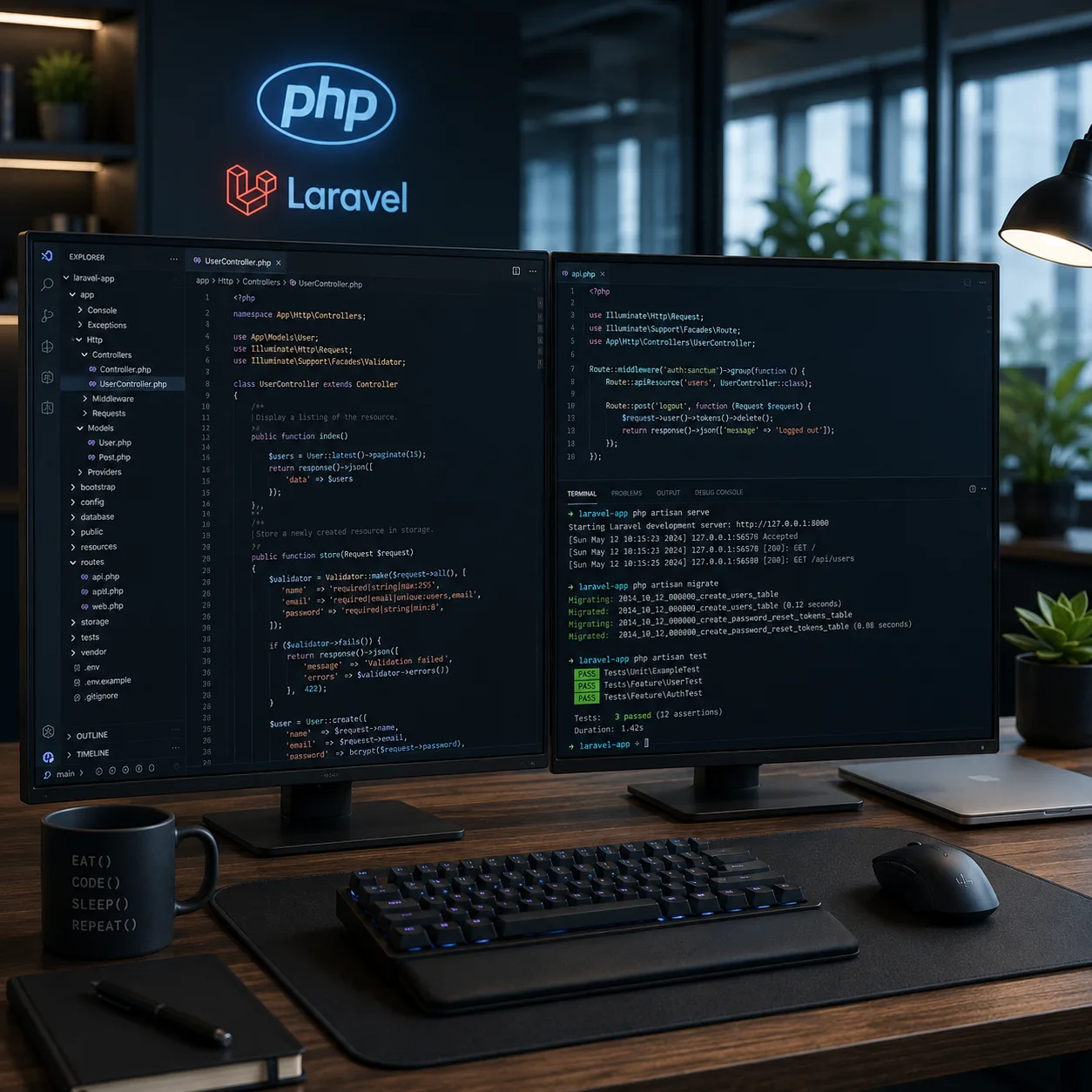
Why PHP Is Still the Right Call for Most Web Applications
Anyone comparing PHP against Node.js or Python for a new project usually ends up asking the wrong question. The real question is not which language is trendier - it's which one gets your admin panel, customer portal or booking system built, hosted affordably, and maintained by developers you can actually find five years from now. PHP runs on almost every shared and VPS hosting plan on earth, has a mature package ecosystem through Composer, and powers everything from small business brochure sites to high-traffic marketplaces. Urgent IT Solution builds on PHP because it lets us match the tool to the budget - a WordPress-adjacent CMS build doesn't need the same stack as a multi-tenant SaaS product, and PHP's flexibility covers both ends without forcing you into unnecessary infrastructure cost.
What We Actually Build
Laravel for structured, long-lived applications
When a project needs Eloquent ORM, queued jobs, scheduled tasks, role-based access control, and a codebase that a second developer can pick up without a two-week onboarding, we default to Laravel. This covers custom ERPs, internal dashboards, subscription billing systems, multi-vendor marketplaces, and API backends that feed a separate React or Flutter frontend. We use Laravel's built-in testing tools (PHPUnit/Pest), migrations for version-controlled schema changes, and Sanctum or Passport for API authentication depending on whether the consuming client is a first-party SPA or a third-party integration.
CodeIgniter for lightweight, fast-to-ship systems
Not every client needs Laravel's overhead. For smaller internal tools, quick MVPs, or systems replacing an old CodeIgniter 3 codebase where a full Laravel rewrite isn't budgeted, CodeIgniter 4 gives a lighter footprint and faster response times on modest hosting. We also maintain and extend existing CodeIgniter 3 applications where migrating to a newer framework isn't yet justified by the client's roadmap.
Core PHP where a framework would be dead weight
Small utility scripts, cron jobs, single-purpose form handlers, or legacy integrations sometimes genuinely don't need a framework's routing layer, service container or ORM. We still write these with PSR-4 autoloading, Composer-managed dependencies, and prepared statements via PDO - framework-free doesn't mean structure-free.
Database and Architecture Decisions We Make Upfront
Before writing application code, we settle the questions that are expensive to reverse later: normalized MySQL/MariaDB schema versus a denormalized reporting layer, whether soft deletes and audit trails are needed from day one, how file uploads and media are stored (local disk versus S3-compatible object storage), and whether the application needs Redis for session storage and caching or can run on file-based sessions for lower traffic volumes. For applications expecting concurrent writes or complex reporting, we also decide early whether raw SQL views or Eloquent query scopes handle the heavy queries - mixing both without a clear rule creates maintenance debt fast.
APIs, Integrations and Third-Party Connections
Most PHP projects today aren't standalone - they need to talk to payment gateways (Razorpay, Stripe, PayU), SMS/WhatsApp APIs, shipping aggregators, or an existing CRM. We build RESTful APIs following consistent JSON response structures, handle webhook verification correctly (signature checks, idempotency for repeated webhook calls), and document endpoints with Postman collections or OpenAPI specs so your internal team or a future developer isn't reverse-engineering the API from source code.
Working With Existing PHP Codebases
A large share of the PHP work we take on isn't greenfield - it's a business that inherited a codebase from a previous freelancer or agency and needs it stabilized. Our approach here is different from a fresh build: we start with a code audit covering PHP version compatibility (many older sites still run on PHP 7.x with deprecated functions that break on 8.x), SQL injection exposure in raw queries, hardcoded credentials, and missing input validation. We then prioritize fixes by risk - security holes and data-loss bugs first, then performance issues like N+1 queries, then code readability. We won't recommend a full rewrite unless the existing code is genuinely beyond safe patching; a rewrite is expensive and risky, and often unnecessary.
Security Practices That Are Non-Negotiable
PHP applications are common attack targets because so many are unmaintained. Every project we deliver uses prepared statements or Eloquent's parameter binding (no string-concatenated SQL), CSRF tokens on state-changing forms, password hashing via bcrypt/argon2 rather than legacy md5/sha1, input sanitization on both client and server side, and HTTPS enforcement at the application level, not just assumed at the hosting layer. For applications handling payments or personal data, we also review session handling and file upload restrictions (MIME type checks, not just file extension checks) since these are the two most common entry points for compromise.
Performance Considerations Specific to PHP
PHP's request-per-execution model means performance work looks different from a persistent Node.js process. We tune OPcache configuration so compiled bytecode is cached between requests, use eager loading in Eloquent to eliminate N+1 query patterns, add database indexes based on actual query logs rather than guesswork, and introduce Redis or Memcached caching for expensive, repeated queries like dashboard aggregates. For traffic spikes, queue workers (Laravel Horizon or a simple database-driven queue) move slow operations like PDF generation or email sending out of the request cycle so users aren't waiting on them.
Hosting and Deployment
We deploy PHP applications on shared hosting, VPS (DigitalOcean, Linode, AWS Lightsail) or managed platforms depending on the traffic profile and budget, configuring Nginx or Apache with proper PHP-FPM pool settings rather than default configs. For applications with a real release cadence, we set up Git-based deployment workflows with separate staging and production environments so changes are tested before they touch live data - a step that's skipped far too often on smaller PHP projects and causes avoidable outages.
What a Typical Engagement Looks Like
We start with a scoping conversation covering the actual data model, user roles, and integrations required, not just a feature wishlist. From there we produce a fixed scope with milestones tied to working, testable increments - a login and role system, then core modules, then integrations, then QA and deployment - rather than a single all-at-once delivery. Post-launch, we offer maintenance covering PHP version upgrades, dependency security patches, and bug fixes, because a PHP application that isn't kept current on its framework and PHP version will eventually stop receiving security patches from the ecosystem itself.
Who This Is For
This service fits businesses needing a custom internal tool that off-the-shelf software doesn't quite cover, companies with an existing PHP/Laravel/CodeIgniter codebase that needs a competent team to extend or stabilize it, and startups building an MVP where PHP's hosting cost and hiring pool make more sense than a heavier stack. It's not the right fit if you specifically need a real-time, high-concurrency system like a live chat platform or trading engine - for those, we'd point you toward our Node.js or WebSocket-based service instead.